China has become an important sourcing base for Fruit Vegetable Juice Beverage Stabilizer solutions. Reliable suppliers support juice producers with pectin, xanthan gum, carboxymethyl cellulose, and blended stabilizer systems. These ingredients help control sedimentation, pulp suspension, cloud stability, and mouthfeel in orange, carrot, tomato, and mixed vegetable juices.
The practical challenge is rarely choosing the strongest additive. It is matching the stabilizer to juice acidity, soluble solids, processing temperature, and storage conditions. Professor D. Julian McClements, a leading food colloid scientist, has stated, “The structure of food determines its properties.” This principle is highly relevant to beverage formulation. A stabilizer may perform well in a laboratory beaker but behave differently after pasteurization or extended distribution.
Real testing matters.
Experienced Chinese suppliers normally examine pH, Brix, viscosity, particle size, and separation after storage. A sample bottle may look uniform on day one, then develop a visible sediment ring after two weeks. That small detail can reveal a major formulation weakness. Pilot trials, dosage comparisons, and compatibility tests provide more dependable evidence than a product brochure.
However, no stabilizer can repair poor raw materials or careless processing. This point deserves honest attention. Some formulations become too thick, cloudy, or slightly gummy when dosage increases. Others lose their fresh texture after thermal treatment. A professional supplier should explain these limitations, provide technical data, and recommend application-specific trials. For buyers seeking a China Fruit Vegetable Juice Beverage Stabilizer supplier, transparent testing, consistent batch quality, and responsive formulation support are essential measures of long-term reliability.
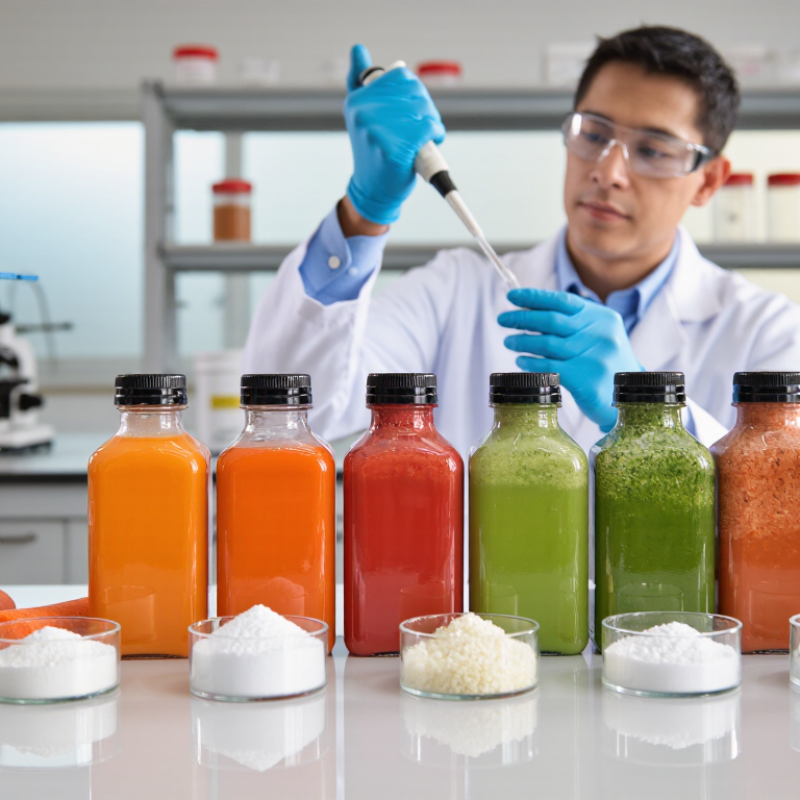
China Top Fruit Vegetable Juice Beverage Stabilizer Supplier
Fruit and Vegetable Juice Beverage Stabilizers: Definition and Core Functions
Fruit and vegetable juice beverage stabilizers are functional ingredients that improve physical stability, texture, and consistency. They help keep pulp, fibers, minerals, and flavor components evenly dispersed during storage. Without proper stabilization, a juice may develop sediment, floating particles, or visible layers.
In practical production, stabilizers can control viscosity and create a smoother mouthfeel. Some support emulsion stability when oil-based flavors are present. Others reduce separation after pasteurization, filling, or transport. The correct choice depends on juice type, soluble solids, acidity, processing temperature, and expected shelf life. Small dosage changes can produce surprisingly different results.
Processing knowledge matters.
A reliable supplier should provide clear specifications, batch records, application guidance, and testing data. Quality checks may include viscosity, pH compatibility, dispersion performance, and storage observation. Trial samples should be evaluated in the actual beverage formula, not only in water. This is where many assumptions fail. A stabilizer that performs well in apple juice may behave differently in carrot juice or a high-fiber blend. Excessive use can create a heavy texture, cloudy appearance, or unwanted aftertaste. I have found that the best formulation is rarely the strongest one. It is the most balanced choice for stability, sensory quality, processing conditions, and consumer expectations.
| Stabilizer | Common Food Additive Code | Definition and Origin | Core Functions in Juice Beverages | Typical Starting Use Level* | Suitable Beverage Applications | Key Formulation Considerations |
|---|---|---|---|---|---|---|
| Pectin | INS 440 | A plant cell-wall polysaccharide, commonly obtained from citrus peels or apple pomace. | Improves cloud stability, helps suspend fine fruit particles, increases body, and reduces serum separation. High-methoxyl pectin can also support gel formation when sufficient soluble solids and acidity are present. | 0.10–0.50% | Cloudy fruit juices, fruit drinks, nectar-style beverages, citrus beverages, and products containing fruit pulp. | Performance depends on pH, soluble solids, calcium content, degree of esterification, and hydration method. |
| Xanthan Gum | INS 415 | A microbial polysaccharide produced by fermentation of carbohydrate substrates. | Provides viscosity at low dosage, improves suspension of pulp and insoluble particles, limits settling, and offers good resistance to acidic conditions and temperature variation. | 0.02–0.15% | Juice drinks with pulp, vegetable juice beverages, smoothies, reduced-sugar drinks, and emulsified flavor systems. | Excessive dosage may create a slimy or stringy mouthfeel. High-shear dispersion is useful for preventing fisheyes and lumps. |
| Carboxymethyl Cellulose | INS 466 | A water-soluble cellulose derivative used as a thickener, stabilizer, and texture modifier. | Builds viscosity, improves suspension, reduces sedimentation, contributes to mouthfeel, and can help maintain a uniform beverage structure during storage. | 0.05–0.30% | Fruit drinks, vegetable beverages, nectar products, flavored juice drinks, and formulations requiring additional body. | Hydration, ionic strength, acidity, and interactions with other hydrocolloids can influence viscosity and clarity. |
| Gellan Gum | INS 418 | A microbial polysaccharide produced by fermentation and available in different gel-strength grades. | Suspends pulp, minerals, and flavor particles at very low use levels; can create a weak network that helps prevent settling while maintaining a relatively fluid beverage. | 0.01–0.05% | Clear or cloudy juice beverages, fortified drinks, vegetable beverages, and products containing suspended particles. | Calcium and other mineral ions can strongly affect structure. Overuse may cause gel particles or an undesirable rigid texture. |
| Gum Arabic | INS 414 | A soluble natural gum collected from selected Acacia species. | Acts as an emulsifier and stabilizer for citrus oils and flavor emulsions, improves mouthfeel, and helps maintain flavor-oil dispersion in beverage concentrates and finished drinks. | 0.10–1.00% | Citrus beverages, cloudy drinks, flavor emulsions, juice-based soft drinks, and beverages containing essential oils. | Its performance is influenced by gum quality, emulsion composition, homogenization, and total soluble solids. |
| Guar Gum | INS 412 | A galactomannan extracted from guar seeds. | Rapidly increases viscosity, enhances body, reduces particle settling, and supports a fuller mouthfeel in beverages containing fruit or vegetable solids. | 0.02–0.15% | Thick fruit drinks, vegetable beverages, smoothie-style products, and high-fiber formulations. | Hydration can be affected by sugar, salts, acidity, and processing temperature. High levels may reduce drinkability. |
| Locust Bean Gum | INS 410 | A galactomannan obtained from the seeds of the carob tree. | Contributes viscosity and body, improves texture, and can work synergistically with other hydrocolloids to support suspension and reduce phase separation. | 0.05–0.30% | Fruit-and-vegetable blends, fiber-containing beverages, thicker juice drinks, and formulations using hydrocolloid combinations. | Requires effective heating and hydration. It is generally used in blends rather than as the only stabilizer in low-viscosity juices. |
| Modified Food Starch | INS 1400–1451, depending on type | Food starch physically, enzymatically, or chemically modified to improve processing and functional performance. | Provides body, improves suspension, enhances freeze-thaw or heat stability in suitable systems, and can help control serum separation in thicker juice beverages. | 0.20–2.00% | Nectar beverages, fruit preparations, vegetable drinks, smoothie products, and beverages with higher pulp or solids content. | The appropriate starch depends on process conditions, shear, acidity, heat treatment, and the desired clarity or opacity. |
| Carrageenan | INS 407 | A family of sulfated polysaccharides extracted from certain red seaweeds. | Provides thickening and suspension support and can interact with proteins or minerals to form structured systems. | 0.02–0.20% | Selected specialty juice beverages, fruit drinks with protein or mineral components, and structured beverage systems. | Use depends strongly on carrageenan type, mineral composition, acidity, and compatibility with other ingredients; excessive use may produce unwanted gelation. |
| Formulation note: The use levels above are practical starting ranges for product development, not universal legal limits. Actual requirements depend on the stabilizer grade, beverage composition, processing conditions, labeling rules, and food-additive regulations in the target market. All stabilizers should be properly dispersed and hydrated before final adjustment of acidity, soluble solids, viscosity, and particle suspension. | ||||||
They are functional ingredients that improve suspension, texture, and consistency. They help keep pulp, fibers, minerals, and flavors evenly dispersed.
They can reduce sediment, floating particles, visible layers, cloud loss, and phase separation. These problems may appear after heating, filling, transport, or storage.
Consider juice type, acidity, soluble solids, pulp level, heat treatment, particle size, and shelf-life goals. The best choice depends on the complete beverage formula.
Pectin can create a smooth mouthfeel in acidic fruit drinks. Xanthan gum supports suspension, while CMC can improve body and reduce sediment.
Not reliably. A formula that works in clear apple juice may fail in carrot juice or a high-fiber blend.
The drink may feel heavy, slimy, or cloudy. It may also develop an unwanted aftertaste. More stabilizer is not always better.
Test the actual formula, including puree, minerals, sugar, acidity, and processing conditions. Check viscosity, pH, sediment, and separation after several storage periods.
Request current lot certificates, batch records, specifications, allergen statements, microbiological limits, and traceability details. Keep sealed samples for later testing.
No. Sensory quality and storage behavior also matter. A product may meet specifications yet develop unstable texture after six months.
The supplier should maintain food safety controls, permitted-use compliance, cleaning records, recall procedures, and raw-material traceability. Missing records deserve attention.
A Fruit Vegetable Juice Beverage Stabilizer is an essential ingredient used to improve the consistency, appearance, and shelf stability of juice-based drinks. It helps prevent pulp settling, separation, sedimentation, and texture changes while supporting a smooth and pleasant drinking experience. Common stabilizer types include pectin, xanthan gum, cellulose-based ingredients, carrageenan, and blended systems, each offering different benefits depending on the juice composition and processing conditions.
When selecting a Chinese supplier, manufacturers should evaluate product safety, batch consistency, technical documentation, production quality controls, and compliance with applicable food regulations. A reliable supplier should also provide formulation guidance, testing support, flexible specifications, and stable delivery capacity. The best stabilizer choice depends on factors such as fruit or vegetable variety, acidity, pulp content, processing temperature, packaging format, target shelf life, and desired mouthfeel. Careful testing helps achieve a balanced beverage with stable quality and strong consumer appeal.

 Tellcan Food